Friday, August 26, 2011

LfW Alice Springs on Twitter


What's all this twittering about?
We've searched high and low, far and wide, but it seems that Land for Wildlife in Alice Springs is now the first of the regional LfW groups to use Twitter.

It seems many of these social networking applications take some time to fully mature, but Twitter has been widely adopted by many in the conservation and NRM world so it was time that LfW took the plunge. It turns out to be a great way of receiving up-to-the-second information about community events and local news.

We're hoping that through our use of Twitter we'll be able to keep our members better in touch with relevant local issues and remain better connected to the NRM community in Alice. It is already proving its worth in spreading the word about the energetic work of voluntary conservationists in Central Australia; our account is being followed by Alice Springs Mayor, Damian Ryan and the Prime Minister of Australia, Julia Gillard. If nothing else, it will be nice to know that messages will be flashing across a screen somewhere in Canberra each day about Mexican Poppy control, buffel-busting, or wildlife corridors through our desert town.

If you're hooked up to Twitter already, you can follow us by looking for @LFW_Alice in your Twitter account - otherwise you can go and investigate by clicking this link to see our profile. If you're not already using Twitter, but might be interested, it's dead easy to sign up and doesn't cost a penny. You can have a look for yourself at http://www.twitter.com/

Thursday, August 25, 2011

Volunteers Needed for Biodiversity Surveys in October


Spencer's Burrowing Frog Opisthodon spenceri.
That's right folks! It's Land for Wildlife biodiversity survey time again and this year promises to be as interesting as ever. The project we have planned will involve 3 nights of trapping at 4 Land for Wildlife properties along Roe Creek - some with excellent Buffel control, and some with extensive Buffel growth. All of the properties around this area have had some interesting mammalian visitors this year so let's see what we find.

We'll start on Sunday the 9th of October and set traps each night through until the Tuesday and finish with our last check on the Wednesday morning. Volunteers with all levels of experience will be needed to help with the setting and checking of Elliot trap lines, pit traps, and funnel traps and the documentation of all that juicy data. Photographers are more than welcome as we will very likely find a few interesting critters along the way.

If you'd like to help out we'd love to hear from you. Give Jesse or Chris a call on 89 555 222 or email lfw@lowecol.com.au

Tuesday, August 16, 2011

Desert Snow!

No, it's not what you think. The weather hasn't gone that crazy - yet. Long time Garden for Wildlife supporter Dave Price has sent in some more of his stunning photographs, this time of an often overlooked desert flower known as Desert Snow Macgregoria racemigera.

Desert Snow Macgregoria racemigera - picture by Dave Price.
This is a species which grows on the sandplains after good rains and may also be found in small depressions that might have a bit of shallow ground water.

Dave tells us, "These little beauties are growing at Kirrirdi south of Yuendumu. I'm told they grow next to the haul road at the Granites and near the bore field. They're called ngapa-taraki-taraki in Warlpiri (ngapa means 'water' and also 'rain') and I'm told that they are an indication of water not far beneath the surface and worth the digging."

More Desert Snow by Dave Price.
Thanks again for some more great images Dave.

Monday, August 15, 2011

Fire Plans - have you got one for your property yet?


Volunteers from Low Ecological Services putting in fire breaks that have already proved crucial in fighting fires to the west of Alice Springs.
We've already seen predictions of large fires for Central Australia vindicated in the past few weeks. Many people have been donating their time and putting in long sleepless nights to protect private property and conservation reserves around Central Australia. Due to the tireless work of regular and volunteer firefighters, there have been no injuries resulting from any of these fires and no loss of housing. The fire season is far from over though, and we may have just received a taste of what is to come.

With the heavy fuel loads on the country at the moment, the destruction of older trees by fire is a more likely outcome. By progressively reducing this fuel through grading and burning breaks, the fires when they do come, are not only easier to get under control, but also less damaging to remnant habitat.
This should be no cause for alarm for property owners around Alice Springs, but should provide ample motivation for the production of fire plans for all properties.

Your fire plan should be simple to follow and known to everyone who is resident on the property. Information about fires in your area can be obtained by listening to ABC Local Radio (783 AM) or by checking the Bushfires NT website.

Land for Wildlife can help you to develop a fire plan for your property, but the important points to cover include;

1. In the event of a fire alert, will you stay on the property or leave - everyone should decide in advance.

2. If you need to evacuate, everyone should travel by the same, pre-determined, safe route.

3. Prevention is better than cure - your fire plan should include all relevant measures to protect your property from being threatened by fire in the first place; fuel reduction burns, fire breaks, and safe access routes.

4. In the event of small spot fires, the fire plan should detail the location of fire-fighting hand appliances and fire extinguishers.

5. The fire plan should have the phone numbers of all relevant emergency authorities that you might need to contact in the event of an emergency.

For more information you can visit the following websites;

Bushfires NT
http://www.nt.gov.au/nreta/natres/bushfires/index.html

North Australian Fire Information - NAFI
http://www.firenorth.org.au/nafi2/
The detailed spatial and temporal fire information that NAFI provides can be very useful in staying abreast of the changing situation at a local level.

Thursday, August 11, 2011

Calling All Buffel Busters!!!


Alice Springs Landcare are having their 2nd Annual Buffel Busting Day on Sunday the 11th of September from 9am to 11am.

It's going to be happening at the Sturt Terraca Arboretum between the Stott Terrace Bridge and Undoolya Rd on the east bank of the Todd. This site has some regenerating native plants and the ongoing removal of Buffel Grass will help these along and allow them to become better established.

Local legend Peter Latz will be delivering one of his famous talks on controlling Buffel Grass. Tools and gloves will be provided and the morning will be spent ripping up weeds and removing litter. Following the Buffel Busting the ASL AGM will occur.

All you are required to bring is as many bodies as you can muster, a hat, water bottle and an enthusiastic Buffel Busting attitude!

Monday, August 8, 2011

Feral Photo Competition


Photo - Yanjing Lu, wikicommons
The Invasive Animals Centre for Cooperative Research has announced its Feral Photos competition. This is a great chance to learn more about how invasive animals impact the equilibrium of our ecosystems and perhaps win a little something along the way. The winning photo will be featured in the 2012 calendar.

All of the details can be found on the Invasive Animals CRC website at; http://www.invasiveanimals.com/feral-photos/

Briefly though, you just need to submit your photograph that features one of Australia's pest animals and its impact or even the monitoring and control measures targeting them. 

Surely someone out there can round up a great feral mouse photo from Alice Springs this season!

Wednesday, August 3, 2011

Treasures of the Desert Knowledge Precinct

Land for Wildlife coordinators recently carried out a property assessment at the Desert Knowledge Precinct. As locals would know, the precinct is located on the Stuart Highway just south of Heavitree Gap and the town of Alice Springs. The property is large (72 Hectares) and managed as a multi-use property, with areas of landscaped gardens, open space and remnant vegetation. Built environments are composed of an education facility, cafe, solar power plant and offices occupied by staff of the Centre for Appropriate Technology.  
The property is situated on old floodplains of St Mary's Creek and the Todd River, with St Mary's Creek a prominent feature where the entry road fords this small tributary of the Todd River. The natural vegetation type of this landscape is Ironwood and Corkwood open woodland with an understorey of native grasses, although introduced Buffel Grass now predominates. River Red Gum and Bastard Coolabah line the channel of St Mary's Creek.
Although the property has a long history of grazing and other potentially degrading land uses, some treasures were uncovered during the assesssment, including:
    
    Ironwood
    
  • This huge Ironwood (Acacia estrophiolata). With a trunk diameter of 85cm, this tree must be several hundred years old. Keeping the area around the base of such trees free from the encroachment of Buffel Grass is important. Hot, frequent fires fueled by thick growth can kill these ancient trees.
  •  
    Scarlet Bracket Fungus
    
  • Scarlet Bracket Fungus (Pycnospora coccineus). A relatively common fungus occuring on dead timber throughout central australia. It varies in colour from bright scarlet, through orange to bleached white. Two colour varieties are shown here.
  •  
    Scarlet Bracket Fungus
    
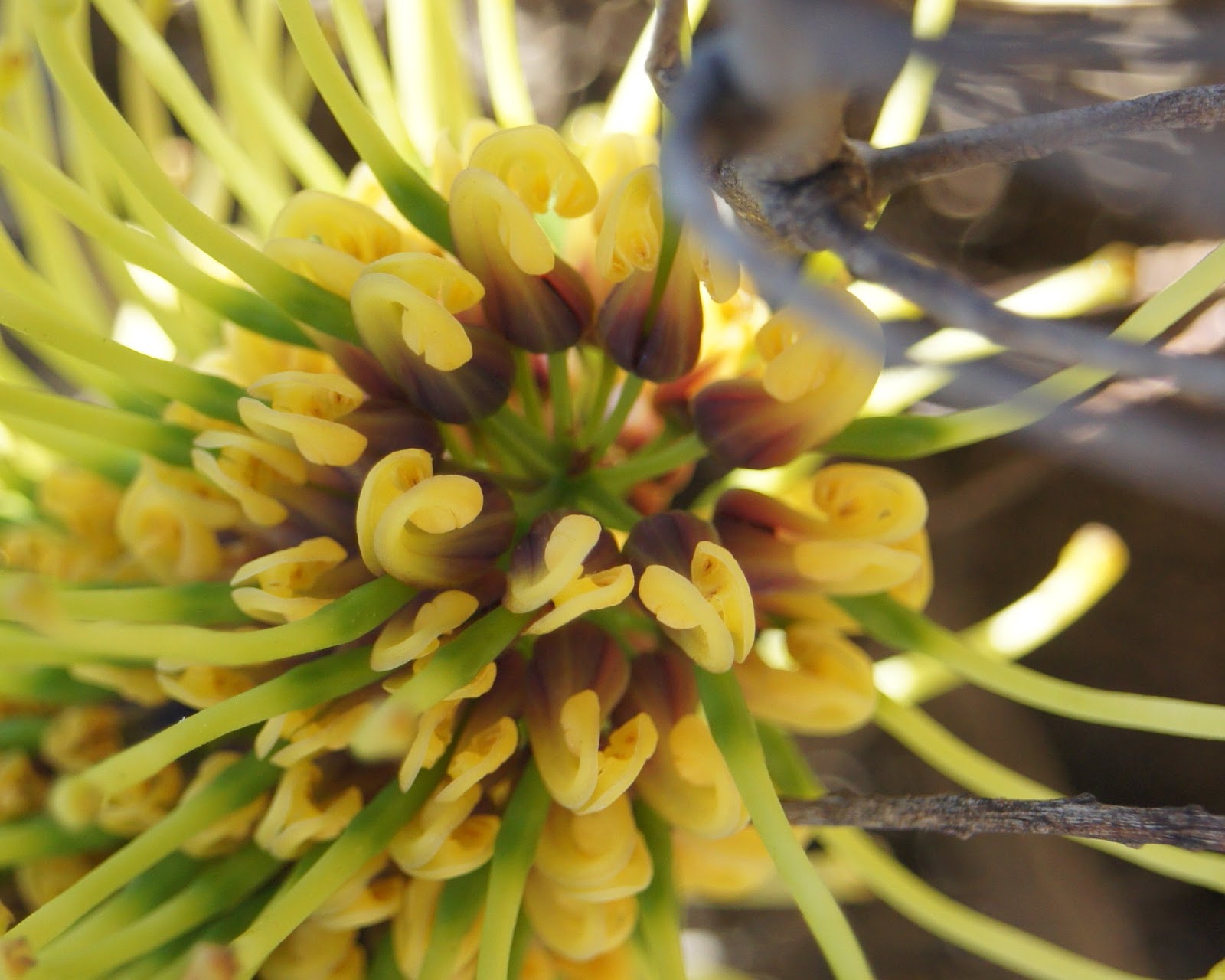
  • Fork Leaved Corkwood (Hakea divaricata). Some very large and old examples of this species occur as part of open woodland communities. Most were in their early stages of flowering during the property assessment. This is one of two species of corkwood that are common around Alice Springs. It is easily recognised by the leaves that fork into several sharp pointed needles.

Fork Leaved Corkwood


The property already has a detailed land and fire management plan, that includes the protection of significant trees, control of Buffel Grass and the maintenance of fire breaks. Land for Wildlife is now developing further recommendations for the management of the property.